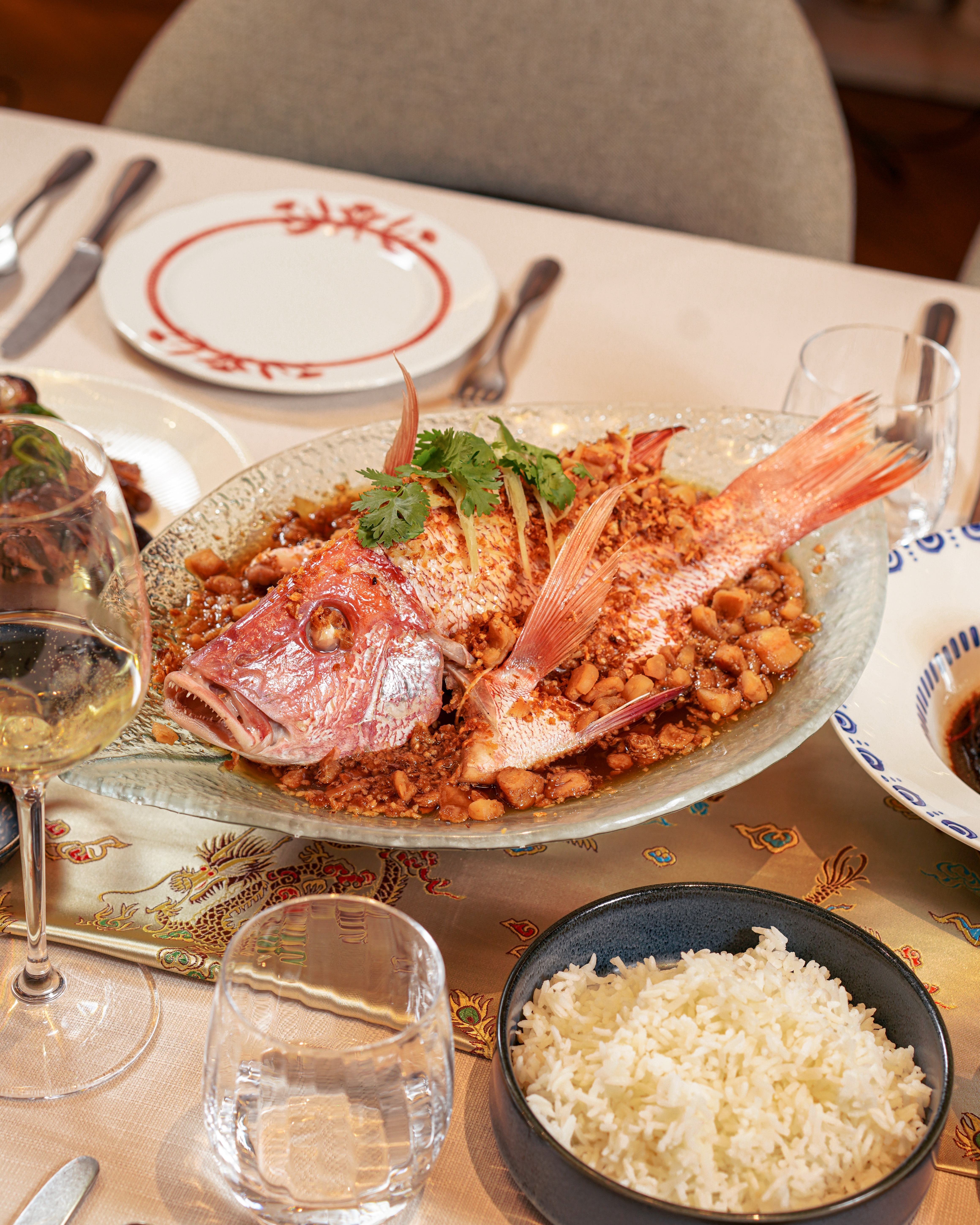
Steamed fish occupies a peculiar place in Singapore’s food culture. It is humble enough to appear at a hawker stall, ladled over white rice for the price of a quick lunch, and formal enough to anchor a Chinese New Year dinner, where the word for fish, yu, carries the promise of abundance. Between those two extremes sits a surprising amount of variation, shaped by the different communities who brought their own steaming traditions to this island and never quite agreed on how the dish should be done.
A Dish With Several Owners
Steamed fish in Singapore does not belong to any single culinary lineage, and that is precisely what makes it worth examining. The technique itself, gentle steam rather than direct heat, is shared across most of the traditions that practise it, chosen because it preserves the natural sweetness and bouncy texture of the fish far better than frying or grilling would. Where the traditions diverge is in what happens around the fish once it leaves the steamer.
Cantonese Style: Letting the Fish Speak
Cantonese-style steamed fish, the version most commonly found across Singapore’s food centres and zi char stalls, tends towards restraint. A whole fish, often seabass, grouper, or red snapper, is steamed until just cooked, then dressed with a savoury sauce built on light soy sauce, finished with a generous scattering of spring onion and fried garlic, and finally hit with a drizzle of hot oil that sets the garnish sizzling at the table.
The restraint is deliberate. Cantonese cooking has long prized the natural flavour of fresh ingredients over heavy seasoning, and steamed fish is perhaps its clearest expression of that principle: the sauce exists to support the fish, never to mask it.
Teochew Style: Sourness as Tradition
Teochew-style steamed fish takes a different approach entirely. Sour plum, preserved vegetables, and tomato are typically added to the steaming process itself, producing a tangy, more assertive flavour profile that suits firmer-fleshed fish particularly well.
This style has deep roots in Teochew culinary history, where pickling and preservation were practical responses to the seasonal availability of fresh ingredients. The sourness has remained a defining characteristic even after that original necessity faded, which says something about how thoroughly a practical solution can become a cultural preference.
Eurasian Style: A Different Kind of Sourness
Eurasian steamed fish takes the question of sourness in an entirely different direction. Instead of relying on preserved vegetables or sour plum, Eurasian kitchens, particularly those within the Kristang community, build their sourness from a fresh rempah, typically chillies, lemongrass, galangal, turmeric, shallots, garlic, candlenuts, and belachan, slow-cooked with green mangoes and accented with citrus leaf, torch ginger, and turmeric leaves.
The result sits closer to a fragrant, herbaceous curry than to the cleaner profiles found in Cantonese or Teochew preparations, reflecting the Eurasian community’s particular gift for combining European technique with Southeast Asian spice. While it is a tradition far less visible in Singapore’s mainstream hawker landscape, it carries just as much history and craft.
Beyond the Familiar: Thai and Claypot Variations
There are further variations still. Thai-influenced steamed fish introduces chilli, lime, and herbs for a brighter, sharper finish, reflecting a culinary tradition that favours acidity and heat in close balance. Claypot preparations, often built around fish head, lean into black bean or curry-based sauces that turn the dish into something closer to a stew, frequently served alongside porridge or noodle at hawker centres across the island.
These variations are a reminder that steaming is a technique, not a fixed cuisine, and Singapore’s culinary diversity has ensured that very few communities have left it untouched.
What Gilmore & Damian D’Silva Brings to the Table

At Gilmore & Damian D’Silva, the Steamed Threadfin Tail draws on this same tradition of variation, offering diners a choice between two distinct preparations rather than a single fixed approach.
The first, Singgang Mangger, is a Eurasian-style assam built from a fine rempah of chillies, lemongrass, galangal, turmeric, shallots, garlic, candlenuts, and belachan, slow-cooked with green mangoes and finished with citrus leaf, torch ginger, and turmeric leaves for a sour, aromatic profile distinct from anything in the Cantonese or Teochew canon.
The second, prepared with Soy Sauce and Chai Poh, leans closer to familiar steamed fish territory, marinated in artisanal soya sauce and enhanced with 10-year-old Hua Tiao Chiew before being steamed and finished with a fragrant oil.
Suitable for six to eight persons and requiring a two-day pre-order, it is a dish built for the same communal, occasion-driven eating that defines so much of Singapore’s food culture.
One Technique and Many Conversations
Steam a fish gently enough, and it becomes a canvas for whichever culinary tradition happens to be holding the spoon. Singapore has never needed to choose a single way of doing this, and the dish is considerably richer for it. Reserve your table here at Gilmore & Damian D’Silva.

Next News & Events
How to Eat Eurasian Food the Way It Was Meant to Be Shared
The more people at the table, the better Eurasian food gets. Here’s how to eat it properly at Gilmore & Damian D’Silva, National Gallery Singapore.